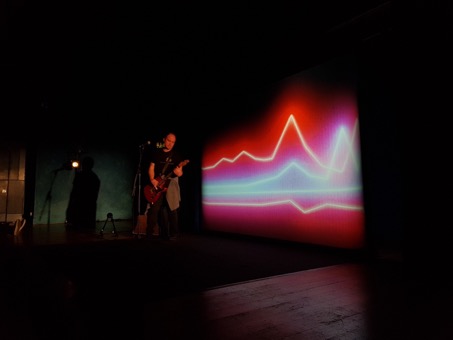
The Studio’s room at Manchester’s Royal Exchange Theatre is quite intimate. The ninety seats are facing a guitar, a microphone and a big screen on the dim-light stage. Only a quote on the screen is softly glowing in the dark: “If you believe that you are a citizen of the world, you are a citizen of nowhere. – Theresa May”. That one sentence is enough to keep the audience guessing whilst they are progressively settling in, and that is all that matter for the actor and playwright, Chris Thorpe, who is already on stage at that moment.
The one-man show untitled “Status”is a one-hour journey show exploring the real meaning of nationality. Chris Thorpe wrote and produced the show with his director Rachel Chavkin. If this 2018 First Fringe winning show is not directly about Brexit, it inevitably has a particular connotation in today Brexit-Britain. After his performance at the Royal Exchange Theatre in September, I met Chris Thorpe before he took up the play across England and Europe at the end of October.
Behind Chris, the big screen displays a line evolving throughout the show into different shapes, drawings and colours’ blocks in accordance to its tone and speech. Now and then, he plays a song with his guitar to give the audience the time to process the dense flow of speech. The spectators are stricken by the passion and the madness coming out of the character’s mouth, and the profound frustration in his eyes. Irina, who saw the play at Manchester’s Exchange Theatre, describes him as “an angry man who is in crisis”.
Chris Thorpe started writing plays in college with his current artistic director at China Plate Theatre and long-time friend, Paul Warwick, who produced Status. If they took two different professional paths in the entertainment industry, they have been working together at the artistic company Unlimited Theatre. Since then Chris hasn’t stop writing plays, performing, whilst participating in plenty other collaborative projects. He says : “I like to look at the things human beings in groups and as individuals are really bad at doing, and to provide even in a tiny way, a space where we can all think about what I can do and what I should do to answer to those questions. It’sabout how does fundamental human problems or needs are expressing themselves at any given moments.” Sometimes it would obviously coincide with a particular event or current phenomenon, like “Status”does with Brexit. “We didn’t know the show would have such an echo when we first started to work, we were simply inspired by the conversation progressively growing in the society through the political debate and the media”, confides Paul Warwick.
In 2009, Chris thought about making a trilogy of plays to better understand the current political and social issues people face in their everyday life. After exploring the confirmation bias (i.e. why we believe what we believe in) in the show called “Confirmation”, Chris wrote the second part of the trilogy, “Status”, to understand how all those individual psychologies form a kind of agreed sense around the notion of nationality. “It is all about things that I can’t work out on my own in the sense that it cries for help. Come to this room, spend some time with me and let’s all think about this because I’m a bit overwhelm when I try alone.”
“Status” is not about Brexit – he never mentions the term throughout the play. However, watching and listening carefully to the show, it is impossible not to think about it. “The show is about the same thing Brexit is the symptom of”, says Chris. He started to work on the play in 2014 while leaving the European Union was not yet an option in the United Kingdom, even though the idea of the referendum was slowly growing within the British government and the media. Chris was fascinated by “the rhetoric of politicians about this very vaguely sense of ‘British values’” in which he personally did not identified with and wondered how people felt about it.
“The profound discomfort I feel when being asked how I perceive my nationality spurred me to make the show”
– Chris Thorpe
Before making the show, he would define himself as a European citizen overall. But “having spoken to people about their nationality all over the world and in parts of England, I realised how useful it is to define myself as a British citizen”. The show starts with a scene that Chris experienced about eighteen years ago in a Serbian bar where the one sentence “I am British” saved him from being arrested by a Serbian police officer. But it is more than an actual fact. “I am British first, and actually I found something defending in that Britishness, defending against the people inside Britain who wants to narrow its definition”. Chris implies that radical beliefs are taking over the definition of “British values” at the cost of more moderate or opposite opinions about it. “The profound discomfort I feel when being asked how I perceive my nationality spurred me to make the show.” Being proud of its own nationality does not make someone a nationalist.
It is obvious that the show generates different debates depending on the general political orientation of the audience. In Manchester, Ryan, a 22-year-old student who saw the one-man show, thought that “all in all the play would help increase this dialogue about what nationality means, what it can be used for, and what the privilege of being a UK citizen drags you. Of course, this discussion is important, especially for young citizens. You can’t not pay attention to politics anymore, there is no escape in it now.”
However, Paul Warwick says: “Chris is very good at talking to people after the show, especially with people who don’t have the same opinions than him” because he can still hold the conversation and sometimes would even be able to deflate the intensity of the debate. Chris remembers when he performed in Devon, a small village in the South East of England, where the majority of the people in the room felt his liberal ideas and did not share the same, some people came up to him after the performance and they ended up in a complete “different conversational space”, explains Chris.
“Status” is an invite to explore our own relationship with our nationality and identity through the experience and reflexion of Chris Thorpe about the multiple perspectives of the borders that shape our world. If at first sight those borders are meant to create order and harmony, he depicts its other aspects throughout the show that would inevitably enhance your own thoughts. That is the reason why Chris likes theatre because it is “an opportunity to give another perspective over a question laying in the mind of every single one of us”. And that is exactly what is happening with “Status”.
Written by Johanna Gayraud
 'Art'-Loud